
9th Armored Division Campaign Map
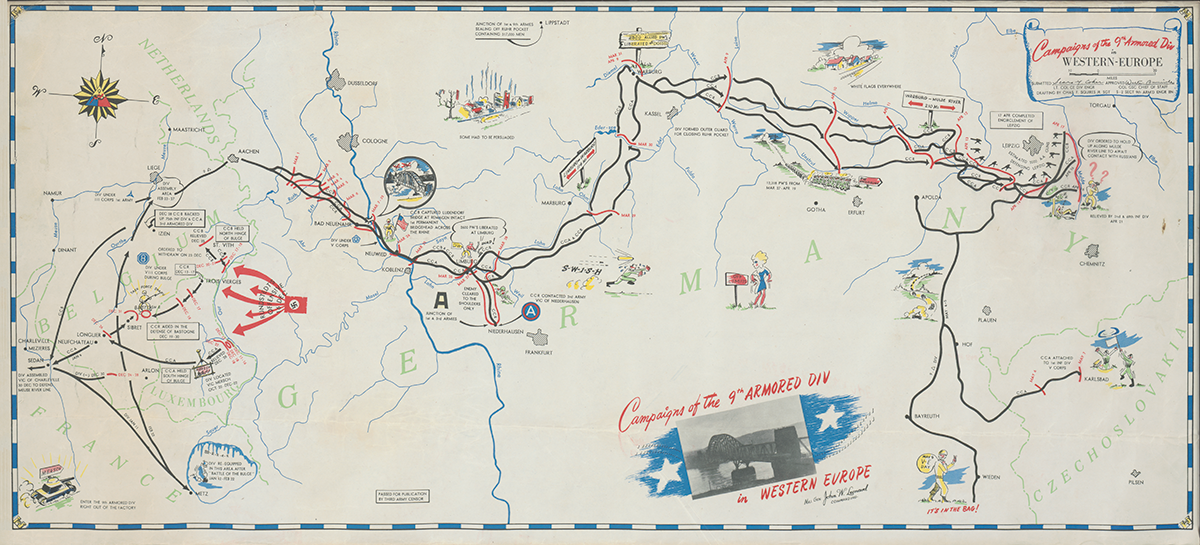
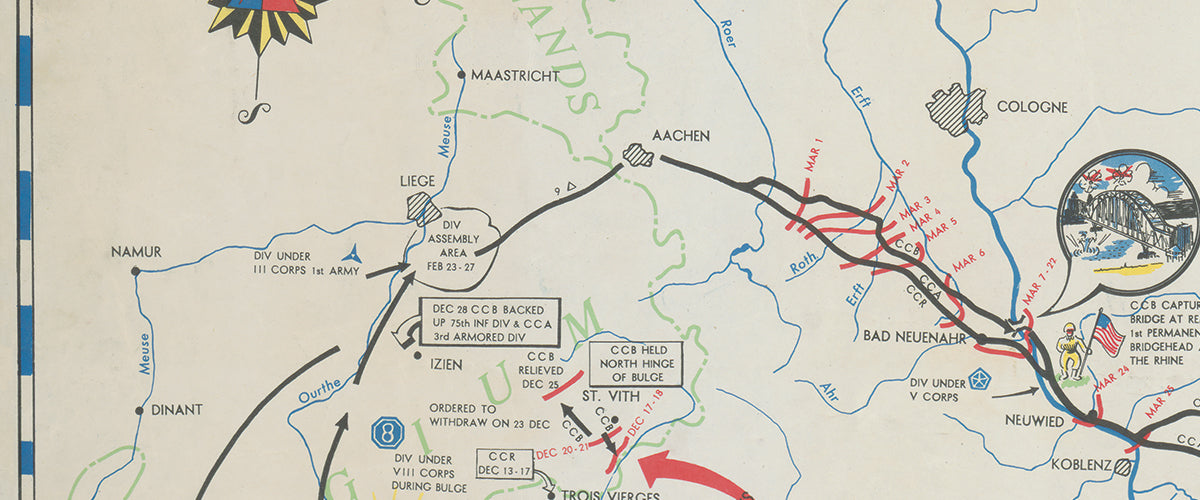
Chart the “Phantom Division’s” path from the Ardennes and Remagen bridge to the Ruhr, Leipzig, Mulde River, and Czechoslovakia.
Size:
29 x 14
9th Armored Division Campaign Map
If you have any questions, you are always welcome to contact us. We'll get back to you as soon as possible, within 24 hours on weekdays.
-
Shipping Information
Use this text to answer questions in as much detail as possible for your customers.
-
Customer Support
Use this text to answer questions in as much detail as possible for your customers.
-
FAQ’s
Use this text to answer questions in as much detail as possible for your customers.
-
Contact Us
Use this text to answer questions in as much detail as possible for your customers.
9th Armored Division Campaign Map
The 9th Armored Division’s route is shaped by two sharply different moments: scattered defensive stands during the Battle of the Bulge and the sudden seizure of an intact bridge across the Rhine. The division arrived in France in autumn 1944 and first held a quiet sector along the Luxembourg-German frontier before the German Ardennes offensive brought it into heavy combat.
Unlike some armored divisions committed as a single striking force, the 9th Armored fought the Ardennes in separated combat commands. Its units were pulled into actions around St. Vith, Echternach, and Bastogne, where they helped delay German movements at several threatened road centers. The division paid heavily, but its dispersed resistance bought time during the opening crisis of the battle.
After rebuilding in January, the division returned to the offensive across the Roer in late February 1945. Its defining moment came on March 7, when elements of the division reached Remagen and found the Ludendorff Bridge still standing. The crossing gave the Allies their first intact bridgehead over the Rhine and changed the shape of the final campaign in western Germany. From there, the 9th Armored helped exploit the bridgehead, moved toward Limburg and Frankfurt, assisted in the Ruhr operations, and advanced east to the Mulde before the war ended.
PAPER & PRINTING
Printed on archival-grade, acid-free matte fine-art paper with a natural surface for crisp detail, accurate color, and lasting display quality.